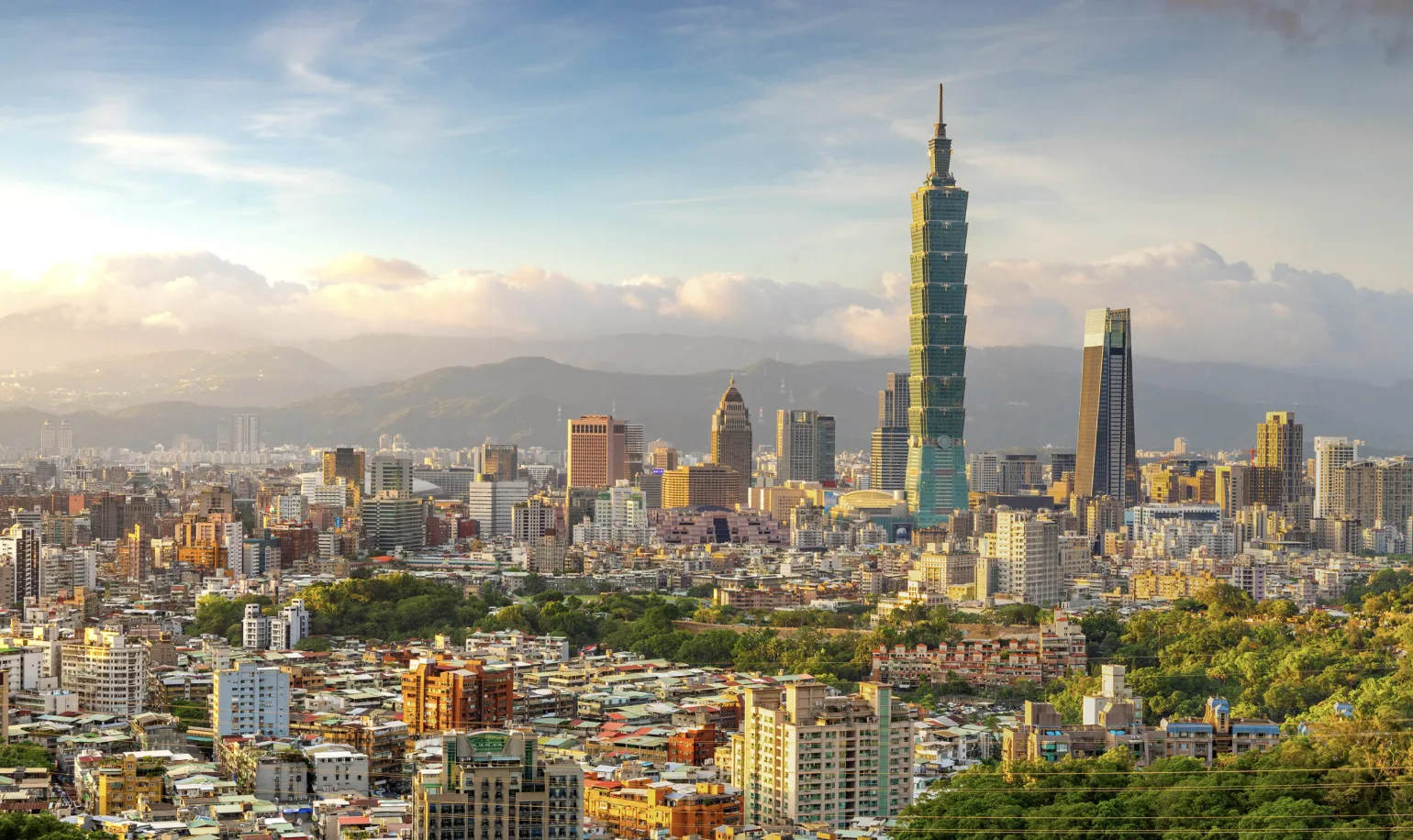
Every AI server in the world is assembled from parts that are made and listed in Taiwan, and over the past three years the companies that make them have been repriced for it, often spectacularly. At Nxos we want to give people the opportunity to move between financial asset classes seamlessly, regardless of where they are. Through our partnership with First Financial, a Hong Kong brokerage, users can now off-ramp directly into the Taiwanese stock market, which has grown into the world's fifth-largest, behind Hong Kong, China and Japan.
Here is how that repricing moved through the chain:
- Every AI accelerator in the world is built from Taiwanese parts, from TSMC's silicon out to the packaging, servers, power, cooling and networking around it.
- The rally moved through the chain in waves, from chip designers and server makers in 2023, to power and cooling in 2024, to memory and advanced packaging through 2025 and 2026.
- Since late 2022, the smaller specialists have run hardest, Elite Material up 3,540% and Asia Vital Components 2,555%, both far beyond TSMC's 527%.
- Memory swung from losses in 2024 to a 290% surge in 2025 as DRAM and HBM prices spiked.
- More and more names keep joining, with 147 Taiwanese tech stocks doubling in the first five months of 2026 alone.
- The whole supply-chain basket has run about four times the TAIEX, which is itself at record highs.
The supply chain against the market
An equal-weighted basket of supply-chain names against the TAIEX, both indexed to 100 at the start of the post-ChatGPT capex cycle in November 2022.
The basket ran roughly four times harder than the broad index. That average is made up of names whose moves arrived in different years, for different reasons, which is the part worth pulling apart.
Returns by tier, year by year
Split the chain into six functional tiers, foundry at the top through chips, boards, systems, power and memory below it, and the calendar-year return of each tier shows leadership moving from one to the next.
| Tier | 2023 | 2024 | 2025 | 2026 YTD |
|---|---|---|---|---|
| Foundry | +28% | +33% | +22% | +104% |
| IC design | +146% | +11% | +8% | +81% |
| Packaging & substrate | +51% | +5% | +87% | +265% |
| Server ODM | +175% | +18% | +22% | +21% |
| Power, cooling & network | +102% | +81% | +107% | +73% |
| Memory | +36% | -38% | +291% | +124% |
In 2023, the first full year of the cycle, the server builders led, up about 175%, with the chip designers behind the accelerators up about 146%; the systems and the silicon designed into them were priced first, where demand was most visible. In 2024 that leadership cooled and the power, cooling and networking suppliers that the new server density required took over, up about 81%, while memory fell 38% in an outright sector recession even as the rest of the chain held. In 2025 memory snapped back by roughly 290%, the largest single-year move anywhere in the chain, and advanced packaging and substrates rose about 87% after two flat years, as they became the step that high-bandwidth memory and large accelerator dies physically run through. That rotation carried into 2026, where packaging and substrates have added a further 265% year-to-date and the foundries re-rated by about 104% as leading-edge capacity tightened. Leadership rarely repeated: the tiers that led in 2023 were middling or worse by 2024 and 2025, and the tiers that looked tired were often next.
The biggest moves were downstream
TSMC returned about 527% over the cycle. Several names further down the chain ran considerably harder. Elite Material, which makes the copper-clad laminates that high-end accelerator boards are built on, returned roughly 3,540%. Asia Vital Components, a thermal-module maker, returned about 2,555%. Accton, which builds the switching that ties AI clusters together, returned about 956%, and Delta Electronics, a power supplier, about 890%. Each beat the foundry at the centre of the story.
The downstream specialists are smaller, their capacity is harder to expand quickly, and the market reached them later, once the constraint had moved from designing and building the systems to powering, cooling, connecting and packaging them at scale. When it did, demand concentrated on a handful of players, and their valuations exploded.
The three biggest movers
The niche names at the very top of that list, a substrate maker, a cooling specialist and a network-switch vendor.
How many names doubled, by year
The same rotation shows up in how many names took part each year.
| Year | Names that doubled | Universe | Share |
|---|---|---|---|
| 2023 | 126 | 940 | 13.4% |
| 2024 | 59 | 969 | 6.1% |
| 2025 | 66 | 985 | 6.7% |
| 2026 YTD | 147 | 983 | 15.0% |
The first year was broad, the middle two years were narrow as leadership concentrated in whichever tier was re-rating, and 2026 has been broad again, 147 names doubling in under five months as the move has turned into a market-wide melt-up.
Where it stands now
The move is still running and has widened into nearly everything attached to the chain. Packaging, substrates and the foundries lead 2026, memory is at fresh highs, and the velocity has picked up in the second-tier names, with United Microelectronics up about 89% in a single month and the passive-component makers Yageo and Walsin up about 127% and 175%. Foreign and local institutions have concentrated their buying in memory, mature-node foundry and components.
Almost all of these names trade in Taiwan dollars on the Taipei exchange, behind a broker relationship that most holders of stablecoin liquidity do not have. Through our partnership with First Financial, a Hong Kong brokerage with direct Taiwan market access, Nxos lets you move straight from a stablecoin balance into these listed names, without assembling the usual stack yourself: the fiat off-ramp, the foreign bank account, the local broker onboarding and the cross-border settlement.