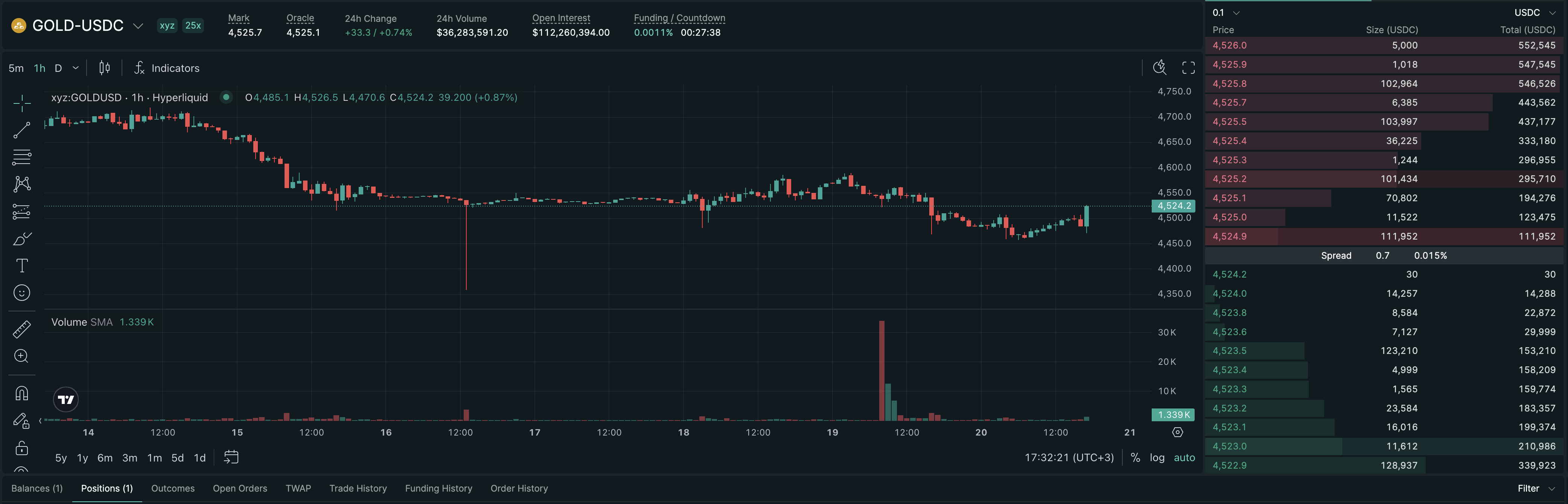
A new class of financial products is forming at the intersection of crypto and fiat: crypto-native primitives made accessible to operators who run their books in fiat, without forcing them to change how they actually trade. Gold is one such case, with a growing body of public data behind it.
Over the last twelve months, funding on Hyperliquid's gold perpetual was positive in 86.1% of hourly windows, averaging 7.6% annualised. A long gold position, whether paper or physical, can be offset by an equal short on the perpetual, leaving the trader delta-flat against the spot price while the funding stream accrues as a yield on inventory they are already carrying.
How gold carry has worked
Every major commodity has carry, and each market has its own mechanic for delivering it: silver holders lease their metal to refiners and fabricators in exchange for a fee, copper traders capture contango on the LME curve, oil markets price storage explicitly. Across all of them the principle is the same, that inventory pays the holder.
Gold has its own version, and it is one of the oldest. Bullion banks and central banks have leased gold for decades, with the rate derived from the spread between USD funding and the gold-forward curve (GOFO). The Bank of England leases reserves to bullion banks, who in turn lend to mining companies hedging production and to jewelry manufacturers funding inventory, with the lease rate historically running around zero to one percent annualised.
The market is wholesale, though, and access has been restricted to LBMA members and the largest bullion houses. For mid-tier physical traders, jewelry holders, ETF investors, and privately held inventory, the lease market has not existed in practice, with storage costs and spot appreciation accounting for the entire return on a position.
What has changed in the past 1-2 years is the emergence of on-chain perpetuals tracking real-world assets, including gold on Hyperliquid. These perpetuals (often abbreviated 'perps') open a separate yield stream on gold inventory, distinct in source from the lease market. Lease rates are paid by refiners, miners, and fabricators who need to borrow physical metal; perp funding is paid by leveraged longs on a derivatives venue to whoever takes the offsetting short. The two yields can move together when gold is in a strong uptrend with crowded long positioning, and they can diverge when it is not. For a physical holder the practical effect is similar: hold the underlying, take an offsetting short, collect the funding stream. The access profile is also different from the lease market, with a position openable on a hundred dollars, sized to any inventory book, and closed at any moment, without LBMA membership or term commitment.
The mechanic
The trade is fundamentally a basis hedge: a physical gold position is long the underlying, an offsetting short perpetual of the same notional brings net exposure to zero, and the trader is left delta-flat on the gold price.
What remains is the funding rate, settled by perpetuals at fixed intervals (every hour on Hyperliquid). The direction depends on the regime: longs pay shorts when sentiment is bullish, shorts pay longs when sentiment is bearish, and the sign of the funding determines who pays whom. In today's regime this is a profitable trade for the hedger, who is in essence rewarded for their long spot position.
In either direction the directional risk on the physical leg is hedged, which is the point of running the basis position in the first place.
What the data shows
Twelve months of PAXG funding history, pulled directly from Hyperliquid's public API reveal:
- 8,760 hourly funding windows.
- Positive in 7,539 of them. 86.1%.
- Mean rate per window: 0.00086%. Annualised: 7.57%.
- Longest sustained positive streak: 392 hours, or about 16 days.
- Max single rate: 0.0165% per hour. Min: −0.098% per hour.
A trader running the basis position throughout the year would have collected funding 86% of the time and paid funding 14%, against a net positive average.
The funding rate peaked in July 2025, softened progressively through Q4 2025 and into Q1 2026, and bounced back in April.
What has kept physical desks out of this trade
The mechanic itself is well-understood; what has not existed is the integration into how a physical desk runs its treasury.
To run the trade, a physical gold trader needs a crypto exchange account, margin posted in a stablecoin or supported fiat, custody arrangements split between the venue and a separate custodian, transaction monitoring that distinguishes hedging from speculative trading, and reporting that ties the perpetual P&L back to the physical book for accounting and audit purposes.
None of that is how a physical desk runs its treasury today, where the operating workflow runs through banks, OTC desks, and the trader's existing accounting stack. Adding a separate crypto-native operating model just to capture a few hundred basis points is rarely worth the friction, so the trade has remained unfamiliar to the desks that could use it most.
The result is that a yield available in the data has not been integrated into the workflow that actually moves a physical book.
What changes when the rails exist
Nxos provides the regulated account, the margin posting (from any supported fiat or stablecoin balance), and the perpetual P&L reporting in the same dashboard as the rest of the trade, with the Hyperliquid relationship sitting behind that. From the trader's perspective, what appears is a hedge position alongside an operating balance, rather than a crypto exchange account that needs to be reconciled separately.
The mechanic is unchanged, and what gets removed is the friction that surrounded it.
Close
The carry has been on Hyperliquid for twelve months, and the integration into how a physical desk actually runs its treasury is what has been missing. Gold here is one case of a broader pattern: a new class of products that sits between crypto and fiat, bringing crypto-native primitives (perpetual funding here, but also tokenised treasuries, on-chain FX, programmable settlement) into reach for operators who run their books in fiat. Whatever else is sitting in the same position across the rest of the commodity stack, or further afield, is probably worth a closer look.
Appendix: how the data was pulled
Hyperliquid exposes a public, unauthenticated API. The script pulls twelve months of funding records for the gold market (PAXG, found by querying meta and matching XAU|GOLD|PAXG), then aggregates positive-window count, mean rate, and longest streak.
Full script: script.